
There is a single valve on your main water line — usually near where the water enters your home, often in a valve box near the front of the house or in the garage — that is quietly protecting every pipe, fixture, and water-using appliance you own. It's called a pressure reducing valve, or PRV, and its job is to step down the municipal water supply pressure to a safe level before it reaches anything in your home.
When it's working correctly, you never notice it. When it fails — and eventually they all do — the consequences range from dripping faucets and running toilets to burst washing machine hoses, water heater failure, and damaged appliances. In the Phoenix Valley specifically, PRVs fail faster than the national average and many older homes don't have one at all. It's one of the most underappreciated parts of a home's plumbing system, and one of the most important things we check on every plumbing service call.
What a PRV Does — and Why It Matters in Arizona
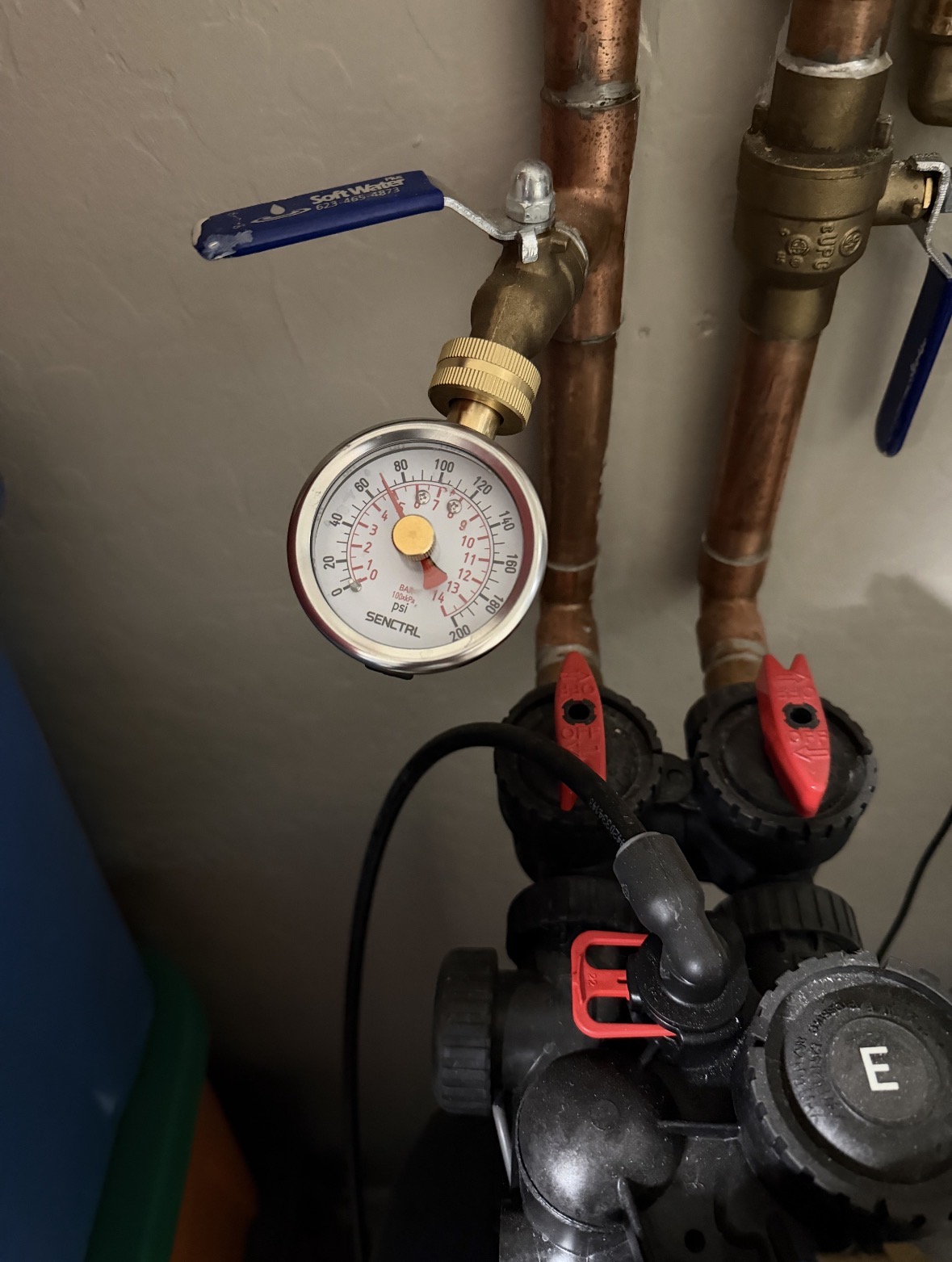
Municipal water systems deliver water at pressures that vary widely depending on the time of day, your location in the distribution network, and how close your home is to a pumping station or water storage tank. In the Phoenix Valley, municipal supply pressure commonly ranges from 80 to over 100 PSI in many areas — and can spike higher during low-demand periods like overnight.
The safe range for residential plumbing is 45 to 80 PSI. The recommended target is 50 to 70 PSI. Above 80 PSI, the stress on your plumbing system is measurable and cumulative:
- Fixture valves and stems wear out faster — leading to dripping faucets that wouldn't otherwise drip
- Toilet fill valves fail prematurely — a running toilet is often a pressure problem, not a toilet problem
- Washing machine supply hoses experience accelerated stress — a burst hose is a common cause of major home water damage
- Water heater supply connections, T&P valves, and internal components wear faster — shortening the life of a $1,000–$2,000 appliance
- Dishwasher inlet valves fail earlier than they should
- Water softeners, reverse osmosis systems, and other treatment equipment perform inefficiently and wear faster
- Pipe joints, soldered connections, and fitting seals experience continuous stress that slowly degrades them
A functioning PRV keeps incoming pressure within that safe window at all times, automatically — no manual adjustment needed during normal operation. It works by using a spring-loaded diaphragm to throttle incoming water flow; the spring tension determines the outlet pressure setpoint. Most residential PRVs are factory-set between 45 and 55 PSI and can be adjusted within a range, typically up to 75 or 80 PSI.
The Arizona-specific problem
Arizona's hard water — 12 to 20+ grains per gallon across most of the Valley — accelerates PRV wear significantly. Mineral scale builds up inside the valve body and on the diaphragm, causing the spring mechanism to lose its ability to regulate pressure consistently. In most of the country, a residential PRV lasts 10 to 15 years. In the Phoenix Valley, the realistic lifespan is 4 to 8 years depending on your local water hardness, usage volume, and incoming municipal pressure. A PRV that's functioning fine at year four may fail noticeably by year six in this water environment. Installing a water softener helps slow that scale buildup throughout your plumbing.
Does Your Home Have a PRV?
Not every home in Arizona has one — and this matters. Current Arizona plumbing codes require a PRV on new construction when the municipal supply pressure exceeds 80 PSI. But many homes built before the mid-1990s were constructed before this requirement was consistently enforced. If your home was built in the 1970s, 1980s, or early 1990s and you've never had a plumber look at your PRV, there's a real chance you either don't have one or have one that's never been checked since installation.
Where to find your PRV
In most East Valley homes, the PRV is located in the valve box near the front of the house, typically alongside the main shutoff valve. In some homes it may be inside the garage near the main water entry point, or in an exterior utility alcove. It has a distinctive bell or dome shape — wider in the middle, narrower at the connections — and usually has an adjustment bolt or screw on top. If you've never seen it or aren't sure whether your home has one, we'll locate and check it on any plumbing service call.
Signs Your PRV Is Failing
Most PRV failures develop gradually, not suddenly. By the time the problem is obvious, it's been affecting your plumbing for months. Here's what to watch for:
High or erratic water pressure
Pressure that feels unusually strong — water that splashes aggressively out of faucets, showers that feel like power washers, or fixtures that make a slight shrieking sound when opened — often indicates a PRV that's no longer holding its setpoint. Pressure that fluctuates noticeably during the day (fine in the afternoon, aggressive in the morning) usually means the PRV is failing to buffer municipal supply variation the way it should.
Banging or hammering pipes (water hammer)
A banging sound when you shut off a faucet, close a valve, or when the washing machine fills and stops is called water hammer — it's the shock wave created when fast-moving water is stopped suddenly. A properly functioning PRV reduces the pressure that causes water hammer. Persistent banging is a strong indicator of PRV failure or excessively high incoming pressure.
Faucets that drip or won't fully shut off
If faucets throughout the house drip even after the cartridge or washer has been replaced, or if replacing toilet fill valves doesn't stop running toilets, high water pressure is frequently the actual cause. The fixture itself isn't the problem — the pressure forcing water past the seal is.
Low pressure throughout the entire house
A PRV that has failed in the closed or restricted direction — rather than failing open — will cause a sudden, whole-house pressure drop. This is often misdiagnosed as a municipal supply problem or a leak. If pressure at the street meter reads normal but pressure inside the house is low, the PRV is a likely culprit — and often the first thing to check before considering a booster pump.
Visible leaks at the PRV itself
Water weeping from the PRV body, dripping into the valve box, or pooling around the valve location indicates the valve's internal seals have failed. A leaking PRV is past the repair stage — it needs replacement.
Age alone
In Arizona's hard water environment, a PRV over 7 or 8 years old should be inspected regardless of symptoms. The internal diaphragm and spring may be degrading before the failure becomes obvious at the fixtures.
PRV Adjustment vs. Replacement
Not every PRV problem requires full replacement. Here's how we assess:
Adjustment is appropriate when:
- The PRV is relatively new (under 5–6 years old in Arizona's water environment)
- Pressure has drifted from the setpoint but the valve is otherwise mechanically sound
- There's no mineral scale on the diaphragm or inside the valve body
- The valve body shows no corrosion, cracking, or weeping
Replacement is the right call when:
- The valve is 7+ years old in the Valley's hard water environment
- There's scale buildup inside the valve body that can't be cleared
- The diaphragm or spring is worn or damaged
- The valve body is leaking, corroded, or shows external damage
- Adjustment has been attempted and pressure still won't hold its setpoint
- The valve collapses (fails fully closed) with no water reaching the house
We always recommend replacement over repeated adjustment on a valve that's already showing wear — a PRV is not an expensive part, and the cost of replacement is a fraction of what a burst water heater connection or failed washing machine hose can cost.
What replacement includes:
- New PRV sized and rated for your supply line (typically ¾" for residential)
- Main water shutoff during installation — usually less than an hour
- Pressure testing at the meter and at indoor fixtures before and after
- Setpoint calibration to 50–65 PSI (adjustable per your preference)
- Main shutoff valve inspection while we're in the valve box
- 5-year workmanship guarantee
New PRV Installation — Homes Without One
If your home doesn't currently have a PRV and your municipal supply pressure runs above 80 PSI, installation is straightforward and typically completed in a single visit. We shut off the main, cut into the supply line at the appropriate point (after the meter, before any branch lines or appliances), solder or thread in the new valve body, restore water, and calibrate to the target pressure.
If you're unsure whether your incoming pressure warrants a PRV, we carry pressure gauges on every truck and can test at your hose bib in about two minutes. Anything above 80 PSI warrants installation; anything above 100 PSI makes it urgent.
PRV and Water Softener — Installation Order Matters
If your home has both a water softener and a PRV (or you're adding one or both), the installation sequence matters. The correct order on your main supply line is:
Meter → Main shutoff → PRV → Water softener → House supply lines
The PRV should be upstream of the water softener — softened water flowing back through the PRV can accelerate internal seal degradation. We install both and can correct an existing installation where the order is reversed.
Service Area
We inspect, adjust, and replace PRVs across our full service territory:
- Queen Creek
- San Tan Valley
- Gilbert
- Chandler
- Mesa
- Tempe
- Scottsdale
- Phoenix
- Anthem
- New River
- Florence
- Apache Junction
- Gold Canyon
- Surprise
- Sun City
Frequently Asked Questions
What is a pressure reducing valve (PRV)?
A PRV is a mechanical valve installed on your home's main water supply line that automatically reduces the incoming municipal water pressure to a safe, consistent level for your home's plumbing system. It uses a spring-loaded diaphragm to throttle water flow — when pressure downstream rises to the setpoint, the valve partially closes; when pressure drops below it, the valve opens slightly. It operates continuously and automatically with no manual input during normal use.
How do I know if I have a PRV?
Look for a bell or dome-shaped valve fitting in your main water line, typically located in a valve box near the front of your home or where the water line enters your garage. It will be on the house side of your main shutoff valve, with an adjustment bolt on top. If you're not sure, we'll locate it during any plumbing service call — it takes about thirty seconds.
What pressure should my PRV be set to?
The recommended residential range is 50 to 70 PSI. Most factory settings are 45 to 55 PSI. We typically calibrate to 55–65 PSI for East Valley homes — high enough for strong fixture performance, low enough to protect supply connections and appliance inlet valves. Above 80 PSI is considered too high by most plumbing codes; above 100 PSI is urgently damaging.
How long does a PRV last in Arizona?
Nationally, PRVs typically last 10 to 15 years. In the Phoenix Valley's hard water environment — 12 to 20+ grains per gallon depending on your city — the realistic lifespan is 4 to 8 years. Mineral scale accumulates on the diaphragm and inside the valve body, degrading the spring mechanism faster than it would in softer-water markets. A PRV that's 6 or 7 years old in Arizona should be inspected even if there are no obvious symptoms yet.
My water pressure is fine — do I still need to check my PRV?
Yes — and this is important. A PRV can fail in two directions: open (too much pressure) or closed (too little pressure). A PRV failing toward open often feels like normal or slightly high pressure before it fails completely, because the valve is partially regulating. By the time pressure at the fixtures clearly feels too high, the PRV may have been inadequately protecting your plumbing for a year or more. Age-based inspection — regardless of symptoms — is the better approach in Arizona's hard water environment.
Can I adjust my PRV myself?
The adjustment bolt on a PRV can be turned to raise or lower the setpoint. However, on a valve that's 5+ years old in Arizona, we don't recommend attempting adjustment without first testing incoming pressure and confirming the valve is mechanically sound. Attempting to adjust a worn or scale-fouled PRV can dislodge internal debris, cause the valve to stick, or trigger a failure. If you want to adjust pressure, let us test the valve condition first.
What's the difference between a PRV and a pressure relief valve?
They're frequently confused because both use the abbreviation "PRV," but they're completely different devices. A pressure reducing valve (the one this page covers) proactively steps down incoming supply pressure before it reaches your home's plumbing — it's always in the line, always working. A pressure relief valve is a safety device on water heaters and boilers that vents water if pressure inside the tank exceeds a dangerous threshold — it sits dormant until that threshold is reached. Both matter; neither substitutes for the other.
Will replacing my PRV stop my faucets from dripping?
Often yes — if high water pressure was the cause. If faucets throughout the house drip and you've replaced cartridges or washers without solving the problem, high pressure forcing water past the valve seat is a very common cause. We test pressure before and after PRV replacement so you can see directly whether it was the source.
Does a new PRV require a permit?
In most Arizona jurisdictions, a PRV replacement on an existing supply line does not require a permit — it's a like-for-like component replacement. A new PRV installation (adding one where none previously existed) may require a plumbing permit depending on local jurisdiction. We'll let you know before the work starts.
Should I replace my main shutoff valve at the same time?
We recommend at minimum inspecting it. When we're working in the valve box for a PRV replacement, we test the shutoff by closing and reopening it. A shutoff valve that hasn't been operated in 10+ years frequently seizes partially open or develops a slow drip when exercised — and you don't want to discover your main shutoff doesn't work during a plumbing emergency. If it's showing any sign of failure, replacing it at the same visit costs far less than a separate service call later.
What brands of PRV do you install?
We install Watts, Zurn (Wilkins), and Honeywell/Braukmann PRVs — all are widely considered the standard for residential applications, carry manufacturer warranties, and are available in lead-free brass to meet current plumbing code requirements. We'll specify the right size and pressure rating for your supply line diameter and incoming pressure.
How much does PRV replacement cost?
PRV replacement cost depends on your supply line size, valve box accessibility, and whether the main shutoff also needs replacement. We provide upfront flat-rate pricing before any work starts — no surprises. Call us at (602) 428-7027 or book online for a same-day assessment.
Not Sure If Your PRV Is Working?
Call us at (602) 428-7027 or book online at ahpofaz.com. We test pressure on every plumbing call and can check your PRV in the same visit — no separate appointment needed.