
Recessed lighting is one of the most requested electrical upgrades we do — and one of the most commonly done wrong. A lighting contractor who doesn't understand what a Phoenix-area attic does in July, or who installs the wrong fixture rating for an insulated ceiling, creates a problem that's invisible until it causes flickering, tripped breakers, or a fixture that keeps shutting off on the hottest days of the year.
We're licensed electricians, not a specialty lighting crew — which means we look at a recessed lighting install the way we look at any electrical job: the wiring, the circuit load, the ceiling construction, and the fixture specifications all matter before the first hole gets cut. You get lighting that looks the way you want and works the way it should, year-round.
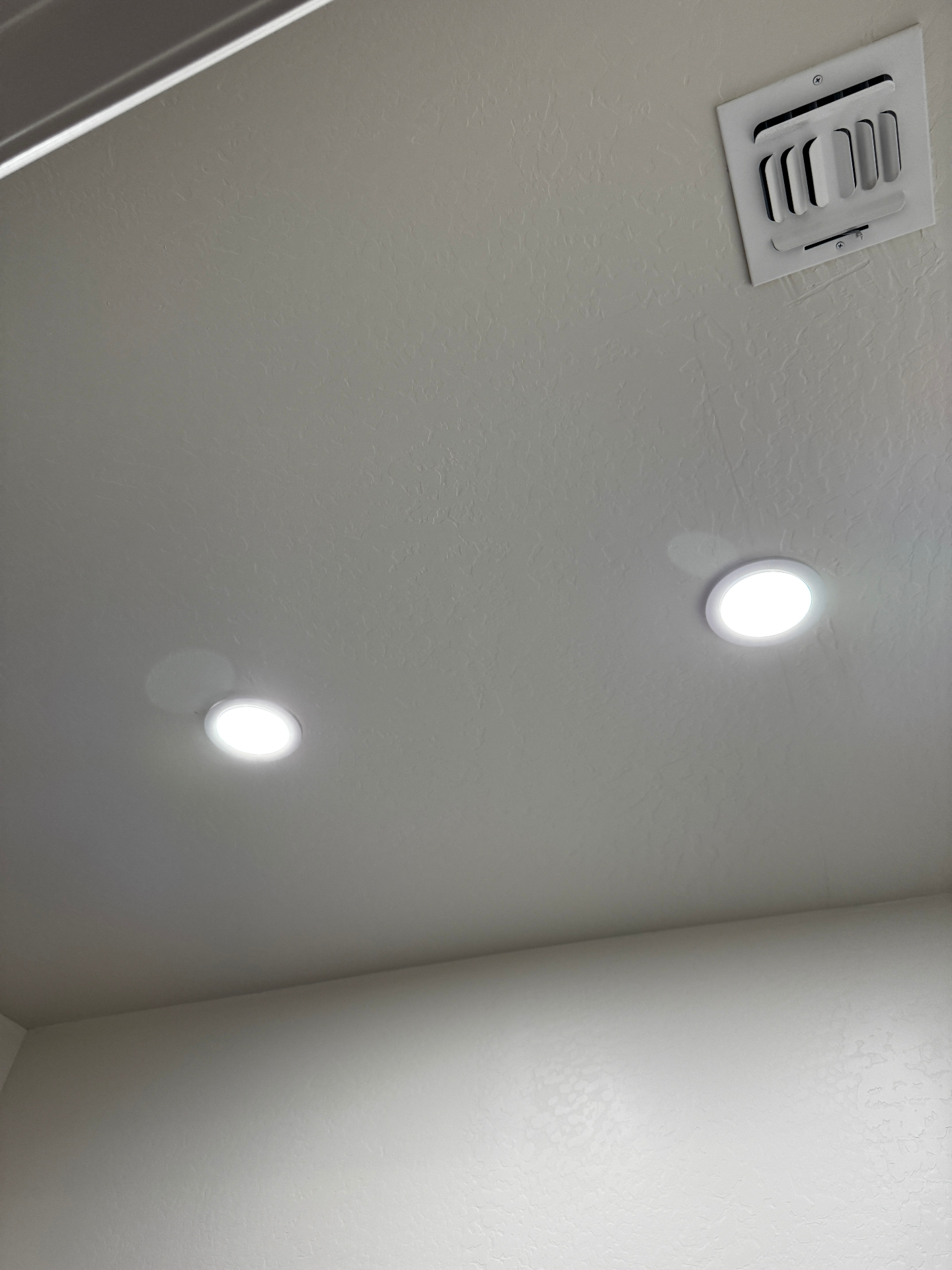
New Recessed Lighting Installation
Whether you're lighting a kitchen remodel, opening up a living room, finishing a bonus room, or adding lighting to a master suite, we plan and install recessed lighting that fits the space — not just the trend. Every new installation includes:
Layout and spacing planning
Fixture spacing determines whether a room feels evenly lit or has bright spots and dark corners. The standard rule of thumb is to divide your ceiling height in half for spacing between fixtures — an 8-foot ceiling typically calls for fixtures spaced 4 feet apart — but room shape, purpose, and natural light sources all factor into the final layout. We plan the grid before any holes are cut.
Circuit assessment
Each lighting circuit has a load limit. Adding 10 recessed fixtures to an already-loaded circuit is a code violation and a fire risk. We check the panel before we start, confirm available capacity, and add a dedicated circuit if needed. We handle the electrical panel work in-house — no coordinating a separate electrician.
Fixture selection
We install LED wafer-style (canless) fixtures and traditional can-style housings depending on the application. For new construction or open-ceiling access, traditional housings with LED trims give more flexibility; for retrofit installs through finished drywall, canless wafer fixtures require a smaller opening and no junction box. We'll recommend the right type for your ceiling construction and tell you why.
Dimmer compatibility
LED fixtures require dimmer switches specifically rated for LED loads — standard dimmer switches cause LED fixtures to flicker, buzz, or fail to dim smoothly. We install compatible dimmers as part of every installation, configured and tested before we leave.
IC and airtight ratings — especially important in Arizona
This is the detail that matters most in this climate and that most generic lighting guides skip entirely. Every recessed fixture installed in a ceiling with insulation above it must be IC-rated (safe for direct contact with insulation). In Arizona, the stakes are higher than anywhere else in the country:
Phoenix-area attics reach 140°F to 150°F during summer. A non-IC-rated fixture installed in an insulated ceiling is — from a thermal standpoint — a one-square-foot hole connecting your 80°F living space to that 150°F attic. Conditioned air escapes up through the fixture housing and into the attic continuously while the light is on. Your AC system works harder, your energy bills climb, and the fixture itself runs hotter than it was designed to.
Beyond energy loss, a non-IC fixture with insulation pushed too close to it is a fire hazard — the whole reason the IC rating requirement exists. We install IC-rated, airtight (ICAT) fixtures on every ceiling application as a standard practice, not an upgrade. It's what the job requires in this climate.
Retrofit Recessed Lighting (Adding Lights to Existing Rooms)
Retrofit installs — adding recessed lighting to a finished room without tearing out the ceiling — are the most common lighting job we do. Modern canless LED wafer fixtures are specifically designed for this application: they clip directly to the drywall from below, connect to existing wiring or a new run, and require only a small circular hole with no access above the ceiling needed in most cases.
We handle:
- Converting existing ceiling boxes (where a fan or chandelier was) to recessed fixtures
- Adding new circuits or extending existing circuits to new fixture locations
- Fishing wire through finished walls and ceilings without unnecessary drywall damage
- Upgrading old can-style fixtures to current IC-rated LED wafers
- Converting incandescent or CFL recessed fixtures to LED throughout the home
Attic access changes the approach significantly. If your home has accessible attic space above the room being lit — common in single-story East Valley homes — running new circuits is straightforward and gives us more flexibility in fixture placement. If there's a second floor above the room or the attic is inaccessible, we work through the ceiling and wall cavities. We'll assess your specific ceiling construction before quoting and tell you exactly what's involved.
Recessed Lighting Repair
Existing recessed lighting acting up? Common issues we diagnose and repair:
Flickering fixtures
Usually caused by one of three things: a dimmer switch that's incompatible with the LED fixtures it's controlling, a loose wire connection at the fixture or junction box, or a fixture that's thermally shutting off due to overheating. In Arizona, the thermal shutoff issue is more common than it is elsewhere — a fixture installed too close to insulation, or a non-IC fixture with insulation pushed against it, will repeatedly shut off on hot days as the thermal protection trips. The fix is replacing the fixture with a properly rated one, not replacing the bulb.
Fixtures that won't turn on
Could be a tripped breaker, a failed fixture, a bad dimmer, or a loose connection. We test the circuit, the switch, and the fixture before replacing anything.
Buzzing or humming
Usually a dimmer compatibility issue with LED fixtures. The fix is a dimmer switch rated for LED load — a five-minute swap once the correct switch is on the truck.
Trim falling out or fitting poorly
Old can-style fixtures use spring clips to hold trim rings in place — the springs weaken over time and trim starts to sag or fall. We replace trim rings or convert old cans to new canless fixtures depending on what makes more sense for the age of the housing.
Water staining around fixtures
Staining around a recessed fixture usually indicates a roof leak or HVAC condensation issue above the ceiling — the fixture is showing the symptom, not causing it. We'll flag it and refer you to the right trade if the source is plumbing or roofing rather than electrical.
Where We Install Recessed Lighting
Kitchen
The most common recessed lighting project. Task lighting over countertops and prep areas, general lighting for the main ceiling, and accent lighting over islands all have different spacing and trim requirements. We plan kitchen lighting as a system, not a grid of evenly-spaced fixtures regardless of how the space is used.
Living room and great room
Open floor plans in East Valley homes often have high or vaulted ceilings that need more fixtures at wider spacing for adequate coverage. We size the layout and circuit load for the actual room dimensions, not a generic formula.
Master bedroom and secondary bedrooms
Bedroom recessed lighting often pairs with dimmer control for ambient flexibility. We install fixtures centered over the bed position where possible and configure dimmers on a 3-way circuit if the room has two entry points.
Bathrooms
Bathroom recessed lighting requires wet-location or damp-location rated fixtures depending on proximity to the shower or tub. We specify the correct rating for every bathroom location — fixtures directly above the shower must be rated for wet locations; fixtures elsewhere in the bathroom require damp-location ratings at minimum.
Outdoor covered patios and soffits
Covered patios are among the most popular lighting projects in Arizona — outdoor living spaces are used year-round and good lighting extends the hours they're usable. We install damp or wet-rated recessed fixtures in covered patio ceilings, soffits, and overhangs, wired on a dedicated exterior circuit.
Home offices, bonus rooms, and casitas
Dedicated workspace lighting is task-oriented — we plan fixture placement based on desk position and work surface location, not just room coverage. Casitas and guest houses may need a subpanel feed if the existing circuit capacity is insufficient.
Garages
Garage lighting is more utilitarian but still benefits from proper spacing and circuit planning. We install recessed fixtures in garage ceilings as standalone jobs or as part of a broader garage electrical upgrade ( EV charger, subpanel, additional circuits).
Why Hire a Licensed Electrician for Recessed Lighting
This comes up on every lighting job. A specialty lighting contractor or handyman can physically put fixtures into holes in the ceiling. A licensed electrician assesses whether the circuit can carry the load, pulls a permit when required, ensures the fixtures are correctly rated for the application, and is accountable for the work under their ROC license.
In Arizona, recessed lighting installations that involve new circuits or service panel modifications require a permit and inspection. Work done without one doesn't just create legal liability — it can affect your homeowner's insurance coverage and your ability to sell the home. We pull permits when the job requires them, and we stand behind the work with our 5-year workmanship guarantee and ROC license.
If the layout you want needs more than your existing circuits can carry, circuit additions and panel capacity are handled by the same crew — see our electrical service and panel upgrade page for how we assess load and upgrade service.
Service Area
Same-day recessed lighting service across our full territory:
- Queen Creek
- San Tan Valley
- Gilbert
- Chandler
- Mesa
- Tempe
- Scottsdale
- Phoenix
- Anthem
- New River
- Florence
- Apache Junction
- Gold Canyon
- Surprise
- Sun City
Frequently Asked Questions
How many recessed lights do I need for my room?
The standard starting point is to divide your ceiling height in half — that gives you the spacing between fixtures. An 8-foot ceiling typically needs fixtures spaced 4 feet apart; a 10-foot ceiling, 5 feet apart. For a 12x15-foot room with 9-foot ceilings, you'd typically need 6 to 9 fixtures depending on the room's purpose and how much natural light it already gets. We lay out the grid during the planning phase of every job so you see the proposed layout before any holes are cut.
What's the difference between IC-rated and non-IC-rated fixtures?
IC stands for Insulation Contact — an IC-rated fixture is designed and tested to be safe when attic insulation touches it directly. A non-IC fixture requires a minimum 3-inch clearance from insulation on all sides. In Arizona, where attics hit 150°F in summer and insulation is essential for keeping that heat out of the living space, installing non-IC fixtures in an insulated ceiling is both a code violation and an ongoing energy problem. We install IC-rated, airtight fixtures as standard on every ceiling application.
Can I add recessed lighting without cutting into the ceiling much?
Yes — modern canless LED wafer fixtures require only a small circular hole (typically 4 or 6 inches in diameter) cut through the drywall. There's no can housing, no junction box required in most cases, and the fixture clips to the drywall directly from below. For retrofit applications in finished rooms, this is the cleanest install method available.
Do recessed lights need their own circuit?
Not always — it depends on what's already on the circuit you're connecting to and how many fixtures you're adding. Each 15-amp circuit can carry up to 1,440 watts of continuous load. Modern LED recessed fixtures typically draw 9 to 15 watts each, so a circuit can handle a large number of LED fixtures. The issue arises when other loads (outlets, appliances, existing lighting) are already on the circuit — we calculate the total load before connecting to any existing circuit and add a dedicated circuit when needed.
Why do my recessed lights keep shutting off on hot days?
This is an Arizona-specific problem we see regularly. Most recessed fixtures have a built-in thermal protection switch that cuts power if the fixture overheats and resets when it cools down. In Phoenix's climate, a fixture that's installed in an insulated ceiling without IC rating — or an IC-rated fixture with insulation pushed against it improperly — runs hot enough in summer to trip the thermal switch repeatedly. The fix is replacing the fixture with a properly IC-rated, airtight unit. Replacing the bulb doesn't solve it.
My recessed lights flicker on the dimmer — what's wrong?
Standard dimmer switches are designed for incandescent loads. LED fixtures require dimmers specifically rated for LED — they work differently and need a compatible control. Flickering, buzzing, or a limited dimming range (lights won't go all the way down) are all signs of a dimmer mismatch. The fix is a new LED-compatible dimmer switch — we carry them on every truck.
Do recessed lights require a permit in Arizona?
Adding new circuits, modifying the service panel, or running new wiring to support recessed lighting typically requires a permit and inspection in most Arizona jurisdictions. Simple fixture replacements on an existing circuit may not. We assess what's required on every job and pull the permit when needed — you don't have to manage that process separately.
How long does a recessed lighting installation take?
A retrofit install of 6 to 8 fixtures in a single room with accessible attic space typically takes 3 to 5 hours including circuit work. Larger projects, rooms without attic access, or installations requiring a new circuit from the panel take longer. We give you a time estimate when we quote the job so you can plan accordingly.
Can you convert my old can lights to LED?
Yes — old incandescent or CFL can-style fixtures can be retrofitted with LED trim modules that snap into the existing housing, or we can replace the entire housing with a new canless LED fixture. If your existing cans are non-IC-rated and your ceiling has insulation above it, we recommend replacing the housing entirely with a proper IC-rated unit rather than just changing the bulb or trim.
Planning covered patio recessed fixtures? See outdoor lighting for damp- and wet-rated patio fixtures, landscape lighting, and permanent roofline trim lights.