
Low water pressure is one of those problems that's easy to adapt to and easy to stop noticing — until you realize your shower has been weak for two years, your dishwasher takes 90 minutes to run a cycle, and your hose barely reaches the back of the yard. It's a quality-of-life issue, but it's also potentially a sign of something worth diagnosing before it gets worse.
At American Home Pros of Arizona, we don't jump straight to "you need a booster pump" on every low-pressure call. We diagnose first — because low water pressure has several possible causes, and a booster pump is the right solution for some of them, not all of them. If a booster pump is what you need, we'll tell you why, size the system correctly for your home, and install it the same day in most cases. If something else is causing the problem, we'll tell you that instead.
What Causes Low Water Pressure in Arizona Homes
Before recommending a booster pump, we assess the actual cause of the pressure problem. The most common culprits in our service area:
Pressure Regulator (PRV) failure or misadjustment
Most homes in the Phoenix Valley have a pressure reducing valve (PRV) installed on the main water line — it steps down the municipal supply pressure to a safe level for your home's plumbing. PRVs typically last 10 to 15 years. When they fail or drift out of adjustment, pressure throughout the house drops suddenly or becomes inconsistent. This is one of the most frequently misdiagnosed causes of low pressure — a PRV replacement or adjustment often costs significantly less than a booster pump installation and solves the problem completely. We check this first.
Municipal supply pressure variation
The Town of Queen Creek's own FAQ notes that residential water pressure varies between 50 and 100 PSI depending on time of day and location in the system. During peak demand periods — mornings and evenings — pressure at the meter can drop noticeably. If your pressure is only weak at certain times of day and normal the rest of the time, the cause is likely the municipal supply, not your home's plumbing. In that case, a booster pump downstream of your meter is the right fix.
Mineral scale buildup in pipes
Arizona's hard water — 12 to 20+ grains per gallon across most of the Valley — deposits calcium and magnesium scale buildup on the interior walls of water supply lines over time. In older homes with galvanized steel pipes, this accumulation can reduce the effective diameter of supply lines significantly, restricting flow to fixtures throughout the house. A booster pump adds pressure; it does not clear scale. If scale buildup is the underlying cause, the long-term solution is repiping, not pumping.
Private well issues
Homes on private wells in rural parts of Queen Creek, New River, Apache Junction, and Gold Canyon can experience low pressure from a failing submersible pump, a waterlogged pressure tank, or aquifer yield declining below the pump's draw rate. These are distinct from municipal-supply pressure problems and require a different diagnosis. We service well-water booster systems and pressure tanks and will assess the specific failure point before recommending a solution.
Elevation and distance from the main
Homes at the end of a long supply run, or on properties where plumbing has to travel a significant distance or elevation change, can experience pressure drop that no adjustment will fix. This is particularly relevant on larger acreage properties in New River and Gold Canyon. A booster pump is often the correct and only solution in these cases.
What a Water Pressure Booster Pump Does
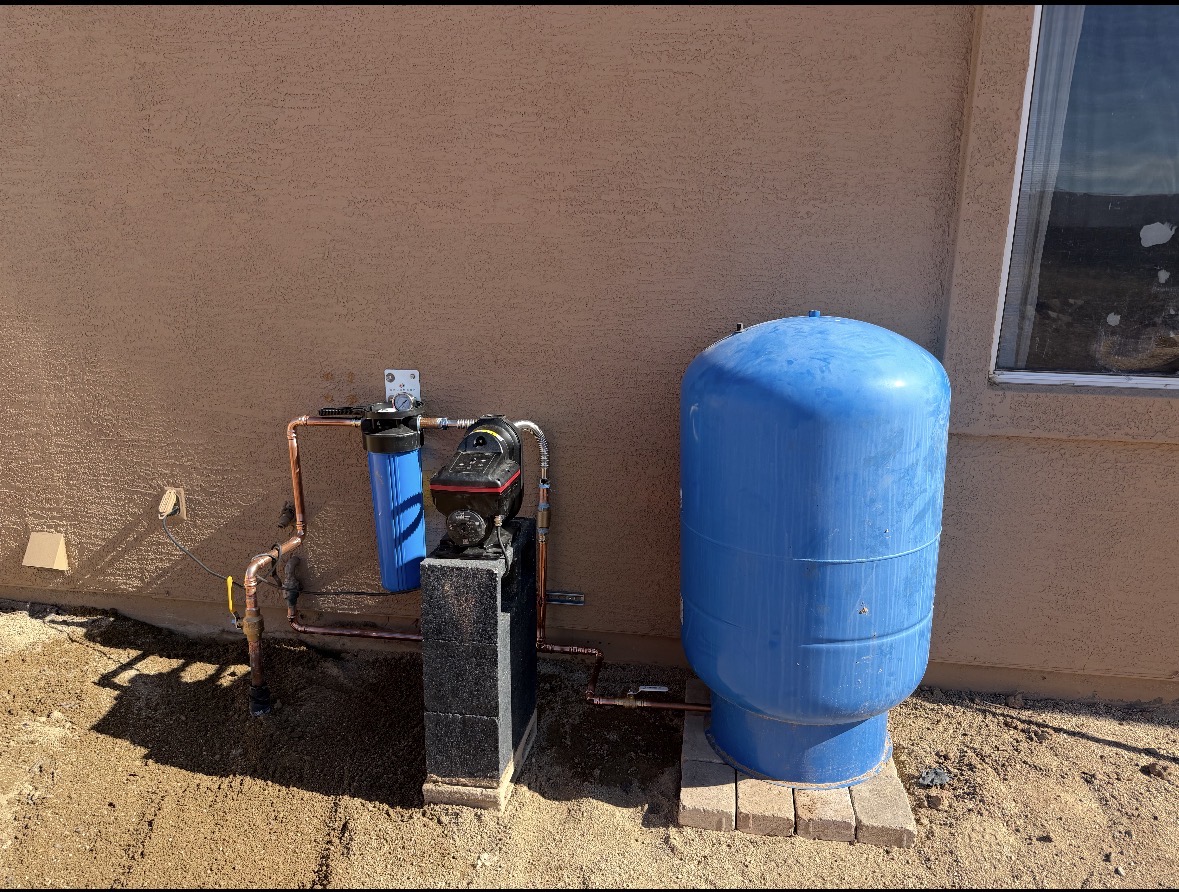
A booster pump installs on your home's main water supply line — after the meter and PRV — and uses a motorized pump to increase water pressure before it reaches any fixture or appliance in the home. Modern residential booster systems include:
- The pump itself — sized to your home's peak demand in gallons per minute and desired pressure increase, typically boosting 20 to 60 PSI over inlet pressure
- A pressurized storage tank — stores water so the pump doesn't have to cycle on and off with every small draw, reducing motor wear and maintaining consistent pressure during simultaneous use
- A pressure switch — automatically starts and stops the pump based on demand; demand-initiated systems only run when needed
- Check valves — prevent backflow into the municipal supply line
- Electrical connection — requires a dedicated 120V or 240V circuit depending on pump size; we handle the electrical work in-house as part of every installation
The result is consistent, strong water pressure at every fixture in the house — showers, faucets, outdoor hose bibs, appliances — even when multiple fixtures are running simultaneously.
Signs You May Need a Booster Pump
- Shower pressure is weak even when no other fixtures are running
- Water pressure drops noticeably when someone else in the house turns on a tap
- Appliances — dishwasher, washing machine — take significantly longer than they should to complete cycles
- Outdoor hose pressure is too weak for effective irrigation coverage
- Pressure at upper-floor fixtures is noticeably weaker than at ground level
- You're on a well and pressure has gradually declined over months or years
- Municipal pressure at your meter consistently reads below 45 PSI
The last point is worth testing directly. We carry pressure gauges on every truck and can give you an accurate reading at the meter during a service call — takes about two minutes and tells us immediately whether the problem is before or after the meter.
Booster Pump Installation — What's Included
Every booster pump installation we do includes:
- Pressure diagnosis — we test at the meter and at multiple fixtures to confirm a booster pump is the right solution and rule out PRV failure, scale buildup, or other causes
- System sizing — we calculate your home's peak demand (gallons per minute) and required pressure increase to select the correctly sized pump and tank; an oversized system short-cycles and wears out faster, an undersized system doesn't solve the problem
- Dedicated electrical circuit — booster pumps require their own circuit; we install it in-house so you're not coordinating a separate electrician
- Full installation — pump, storage tank, check valves, pressure switch, all plumbing connections, bypass valve
- System testing — we verify pressure at multiple fixtures before we leave and confirm the pump is cycling correctly
- 5-year workmanship guarantee on all installation work
The dedicated electrical circuit is handled by our own licensed electricians — one crew, one visit, no separate contractor to coordinate.
Booster Pump Repair & Service
Already have a booster pump that's not performing the way it used to? We diagnose and repair existing systems across all major brands. Common issues we see:
- Pump runs constantly without building pressure (failed pressure switch or check valve)
- Pressure fluctuates rapidly (waterlogged pressure tank — tank has lost its air charge and needs recharging or replacement)
- Pump won't start (electrical failure, failed motor, or tripped breaker)
- Pressure is better than before but still inconsistent (undersized system for actual household demand)
- Pump is noisy or vibrating excessively (worn impeller, cavitation, or mounting issue)
- Visible leaks at pump connections or tank fittings
A waterlogged pressure tank is the most common booster pump service call we make — the bladder inside the tank fails over time, the tank fills with water instead of maintaining an air charge, and the pump starts short-cycling (running for two seconds, stopping, running again) with every small draw. It's usually a tank replacement, not a pump replacement, and it's a straightforward repair.
Well-Water Booster Pumps
Homes on private wells have a different pressure system architecture than municipal-supply homes — a submersible pump at the bottom of the well delivers water to a pressure tank inside or near the house, which maintains system pressure between pump cycles. Low pressure in a well-water home can come from:
- A failing submersible pump (reduced output as the pump wears)
- A waterlogged pressure tank (same bladder failure described above)
- A well yield problem — the aquifer isn't recovering fast enough to keep up with demand, which is becoming more relevant across Arizona as groundwater levels decline in some areas
- A pressure tank that was correctly sized when installed but is undersized for current household demand
We diagnose the specific failure point, replace or repair what's actually failing, and in cases where supply yield is the limiting factor, we can install an intermediate storage tank and dedicated booster to decouple household pressure from the well's draw rate — delivering consistent pressure even when the well is recovering slowly.
Where We Install & Service Booster Pumps
Same-day booster pump service across our full service territory:
- Queen Creek
- San Tan Valley
- Gilbert
- Chandler
- Mesa
- Tempe
- Scottsdale
- Phoenix
- Anthem
- New River
- Florence
- Apache Junction
- Gold Canyon
- Surprise
- Sun City
Well-water booster service is available in Queen Creek, New River, Apache Junction, Gold Canyon, and other rural East Valley and North Valley properties on private well systems.
Frequently Asked Questions
How do I know if I need a booster pump or just a PRV repair?
The fastest way is to have us test your pressure at the meter versus at fixtures throughout the house. If pressure is low at the meter, the problem is municipal supply and a booster pump is the right fix. If pressure is normal at the meter but low at fixtures, the PRV, scale buildup, or a specific supply line problem is more likely the cause — and cheaper to fix. We do this diagnostic on every low-pressure call before recommending anything.
What's the normal water pressure range for a home?
Residential water pressure should generally be between 45 and 80 PSI. Below 45 PSI and most fixtures feel weak; above 80 PSI and you risk accelerating wear on fixture valves, appliance supply lines, and water heater connections. The Town of Queen Creek notes municipal supply varies from 50 to 100 PSI depending on time of day and location — if your home consistently reads below 45 PSI at the meter, that's a legitimate case for a booster pump.
Does a booster pump require a permit?
In most Arizona jurisdictions, a booster pump installation that includes an electrical connection requires an electrical permit. We handle permit coordination as part of the installation — you don't need to manage that separately.
How long does installation take?
Most residential booster pump installations take three to five hours — that includes the plumbing, electrical, and system testing. In most cases, water is only shut off for a portion of that time.
Will a booster pump increase my water bill?
A booster pump uses electricity, not additional water. Your water usage shouldn't increase — if anything, better pressure means appliances like dishwashers and washing machines run more efficiently. The electrical cost for a properly sized residential booster pump is typically modest, similar to running a small appliance.
Can a booster pump fix pressure in just one area of the house, like a bathroom addition?
A whole-home booster pump increases pressure throughout the entire supply system. If the problem is isolated to one fixture or one area — a bathroom addition at the end of a long run, for example — a point-of-use booster or a supply line upsizing may be a more targeted and cost-effective solution. We'll recommend the right approach for your specific layout.
Do you service brands you didn't install?
Yes — we service and repair all major residential booster pump brands regardless of who installed the original system.
Dealing With Low Water Pressure?
Call us at (602) 428-7027 or book online at ahpofaz.com. We'll diagnose the cause the same day and give you a straight answer before recommending a solution.