I'm going to say something that the packaging on roughly a dozen products in your bathroom right now would disagree with: flushable wipes are not flushable.
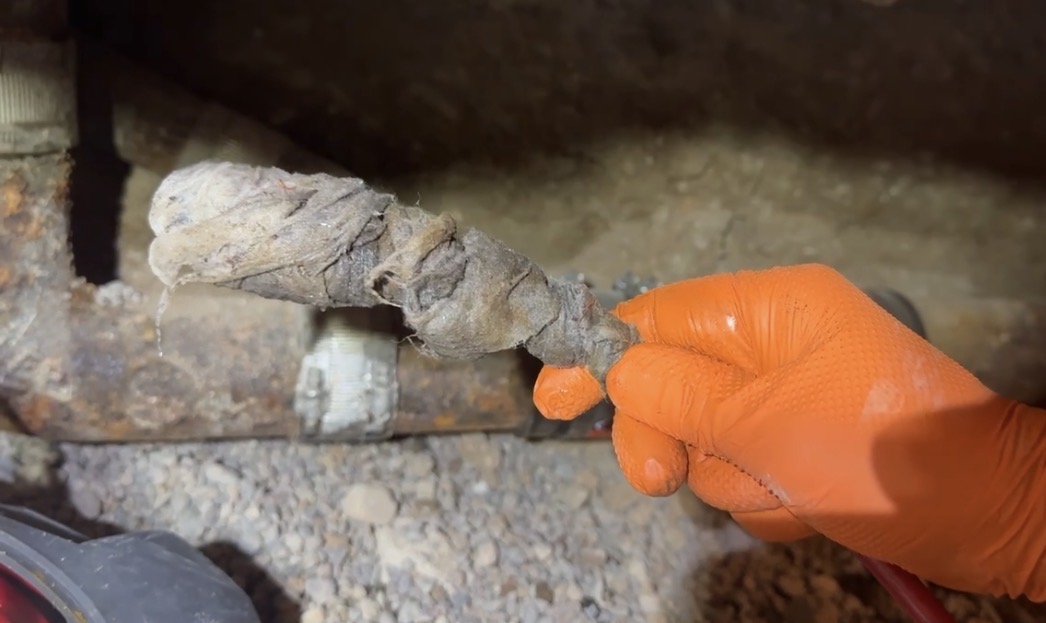
I don't mean they won't go down the toilet when you flush. They will — that part works fine. What I mean is they do not break down inside your plumbing system. And the gap between those two things is the reason we pull dense, rope-like masses of intact wipes out of sewer lines across the East Valley on a regular basis.
I've been in plumbing long enough to watch this problem get worse every year as more wipe products hit the market with "flushable" on the label. So I want to explain exactly what's happening inside your pipes when you flush one, why it matters, and what we actually see on the job — because I think if more homeowners understood it, they'd stop buying the "flushable" claim entirely.
What "Flushable" Actually Means on the Label
Here's the honest answer: it means the wipe will clear your toilet bowl when you flush. That's it. It's not a claim about what happens downstream.
Toilet paper is engineered specifically to dissolve in water. Drop a sheet of toilet paper in a glass of water, give it thirty seconds, and it starts falling apart. That's by design — it has to break down quickly to pass safely through your home's drain lines, through the municipal sewer system, and into a treatment facility without causing problems anywhere along the way.
Now drop a "flushable" wipe in that same glass of water. Come back in an hour. It's still a wipe.
The wipe is made of synthetic fibers — often polyester or a polyester-cotton blend — that are far more durable than paper. They're designed to hold together when wet, which is the whole point of the product. That durability doesn't go away when you flush it. It makes the trip through your toilet just fine and then keeps right on being a durable, intact wipe inside your sewer line.
What Happens Inside Your Pipes
Your home's drain and sewer lines have bends, joints, and narrowing points throughout. In older East Valley homes — built in the 1980s and '90s in established Gilbert, Chandler, and Mesa neighborhoods — those lines may also have minor root intrusion, slight pipe sag, or joint offset that creates natural catching points for debris.
A wipe that makes it through your toilet and into the line doesn't travel cleanly through. It snags. It folds. It catches on a root tendril or a rough joint edge. And then the next wipe catches on it. And the next.
Meanwhile, every time you wash dishes, every time soap goes down the drain, every time cooking grease gets rinsed off a pan — that material is coating the interior of your pipes and binding to whatever is already there. What starts as a few wipes becomes a dense, fibrous mass of wipes and grease that restricts flow and eventually blocks the line entirely.
We've pulled clogs from sewer lines that were clearly the result of years of wipe flushing — solid masses the consistency of a rope, two to three feet long, completely filling the pipe diameter. No plunger touches something like that. It takes a motorized snake to break it up and often hydro jetting to clear the line completely. If you're noticing early warning signs, our drain cleaning service can catch it before it becomes a full backup.
It's Even Worse If You're on Septic
If your home runs on a septic system — common in parts of Queen Creek, New River, Apache Junction, and Gold Canyon — the consequences of flushing wipes are more serious and more expensive.
A septic system depends on bacterial breakdown of organic waste inside the tank. Solids that can't be broken down accumulate and have to be pumped out. Wipes — being synthetic fiber — don't break down at all. They go straight to the solid layer in the tank and stay there, accelerating the rate at which the tank fills and needs to be pumped. Over time, they can also reach the drain field and clog the distribution system, which is a repair that can run into the thousands of dollars.
If you're on septic and you've been flushing "flushable" wipes, stopping now is genuinely important — not just a precaution.
The Only Things That Should Go Down a Toilet
I get asked this more than you'd expect, so here's the definitive list from someone who spends a meaningful portion of his life clearing drains:
Flush only
- Toilet paper — standard single or double ply; dissolves properly
- Human waste
Never flush — regardless of what the packaging says
- "Flushable" wipes of any brand
- Baby wipes
- Makeup remover wipes
- Disinfecting wipes
- Paper towels or facial tissues (Kleenex does not dissolve like toilet paper)
- Cotton balls or cotton swabs
- Feminine hygiene products
- Dental floss (wraps around everything and binds clogs together)
- Medications (take these to a pharmacy take-back program instead)
- Anything described as "disposable" that isn't toilet paper
A useful rule of thumb: if it doesn't say "toilet paper" on the package, it doesn't go in the toilet. Full stop.
What to Do If You've Been Flushing Wipes
If you've been flushing "flushable" wipes regularly — especially for more than a year or two — your sewer line may already have accumulation that's narrowing flow even if you haven't had a full backup yet. The warning signs to watch for:
- Toilets that drain more slowly than they used to
- Gurgling sounds from drains when other fixtures are running
- Drains anywhere in the house that are slower than normal
- A toilet that occasionally needs two flushes
These are early indicators that something is building up in your main line. The smart move at this stage is a professional drain cleaning and camera inspection — we run a camera through the line and show you exactly what's there. If there's accumulation, hydro jetting clears the full pipe interior and resets the clock. If we catch it before a full backup, the job is faster, less disruptive, and less expensive than dealing with a complete blockage.
If you're already at the "drain won't move at all" stage, call us — we offer same-day drain service across Queen Creek, Gilbert, Chandler, Mesa, Tempe, Scottsdale, Phoenix, Anthem, and the rest of our East Valley service area.
One More Thing — Pass This Along
The "flushable" wipe industry is a multi-billion dollar market, and the labeling isn't going to change on its own. Municipal water utilities across the country spend millions of dollars every year clearing wipe-related blockages from their systems — it's a recognized enough problem that many utility providers have launched public education campaigns specifically about it.
The most effective thing that changes behavior on this is homeowners telling other homeowners. So if you've been flushing wipes and didn't realize this was a problem — now you know, and you can pass it along. Share this post, text it to a neighbor, mention it to your family. It's one of those things where the more people know, the fewer calls I get at 8 p.m. on a Sunday for a main line backup.
And if your drains are already giving you trouble, we're here. Schedule a drain cleaning or camera inspection online, or call us directly at (602) 428-7027. Same-day service, upfront pricing, and a straight answer about what's actually going on in your pipes.
— Brandon
Owner, American Home Pros of Arizona
Drains acting up?
Same-day drain cleaning and camera inspection across the East Valley and Phoenix metro.